
Health & safety

COSHH Awareness

COSHH awareness for cleaning, catering, maintenance and workshop staff in Great Britain: what COSHH covers, how to read a label's hazard pictograms and signal words, the safety data sheet sections to read first, COSHH's order of controls with PPE last, and how to protect your skin and breathing.

  • 25 min
  • 5 lessons
  • English
  • United Kingdom
  • Last reviewed 21 November 2026

Covers: Great Britain (COSHH Regulations 2002 as amended; GB CLP); Northern Ireland: COSHH (NI) 2003 with the same regulation numbers, EU CLP with the same pictograms

What you will learn

  • What COSHH covers

    Explain what COSHH covers, including dust and fumes your own work creates, and which substances have their own rules: lead, asbestos and radioactive substances.

  • Reading a label

    Recognise the hazard pictograms by HSE's names, and tell the signal words "Danger" and "Warning" apart.

  • Safety data sheets

    Find what you need in a safety data sheet: the hazards, handling and storage, protective equipment, first aid and spills.

  • Controls and your duties

    Describe the order of controls COSHH sets, with PPE last and in addition, and your own duty to use controls and report defects.

  • Safe habits

    Protect your skin and breathing, never decant into unlabelled containers or mix products, and report symptoms early.

How this course was checked

  • More than 160 statements traced to 7 sources
  • Checked twice, independently, before publication. Every correction was checked again.
  • Last reviewed 21 November 2026. Next review due 21 November 2027.

What changed

  • 1 First published.
Spotted something wrong or out of date? Report an error

Report an error

Tell us what looks wrong or out of date in COSHH Awareness, and where. We check every report against the sources and correct the course if needed.

Lessons

1 module, 5 lessons

  1. COSHH awareness

    • What COSHH is and who does what What COSHH covers and doesn't, how substances get into the body, and your employer's duties and yours.
    • Reading the label Signal words, the hazard pictograms by HSE's names, and the hazard statements that go with them.
    • Safety data sheets and controls Your right to see a safety data sheet, the five sections to read first, and COSHH's order of controls.
    • Skin, breathing and safe habits Dermatitis and asthma, Avoid, Protect, Check, and practice with decanting and mixing.
    • Check your understanding Eight questions on the whole course. You need 80% to pass.

Try the first lesson

This is the first lesson exactly as your learners will see it. The rest of the course opens in your own portal.

Lesson 1: What COSHH is and who does what
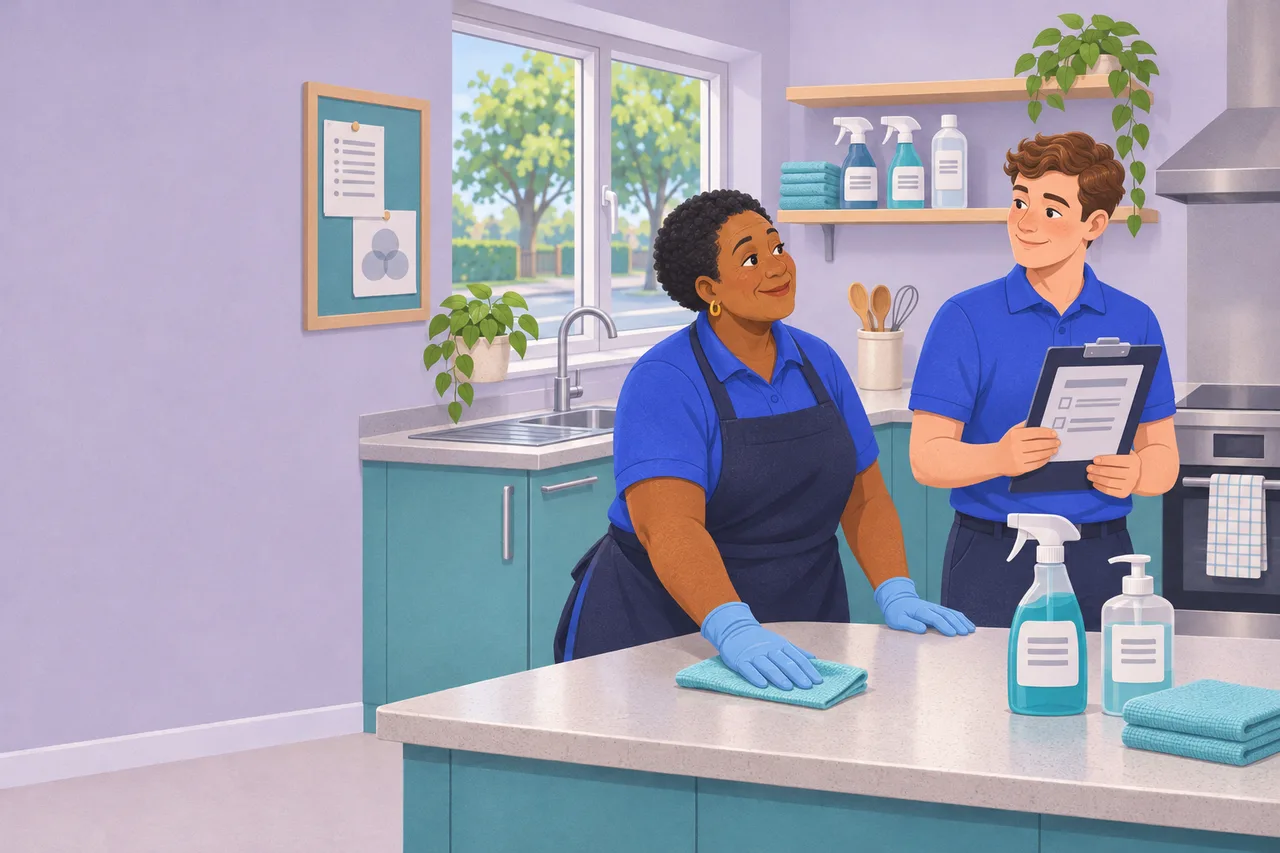
In a bright care home kitchen, a care worker in disposable gloves and an apron wipes down a worktop, smiling at a colleague

Read the label, use the controls, protect yourself

What COSHH is and who does what

Bleach in a cleaning cupboard, flour dust in a bakery, fume from a welding torch: all of them can harm your health at work. The law that controls them is COSHH, the Control of Substances Hazardous to Health Regulations 2002.

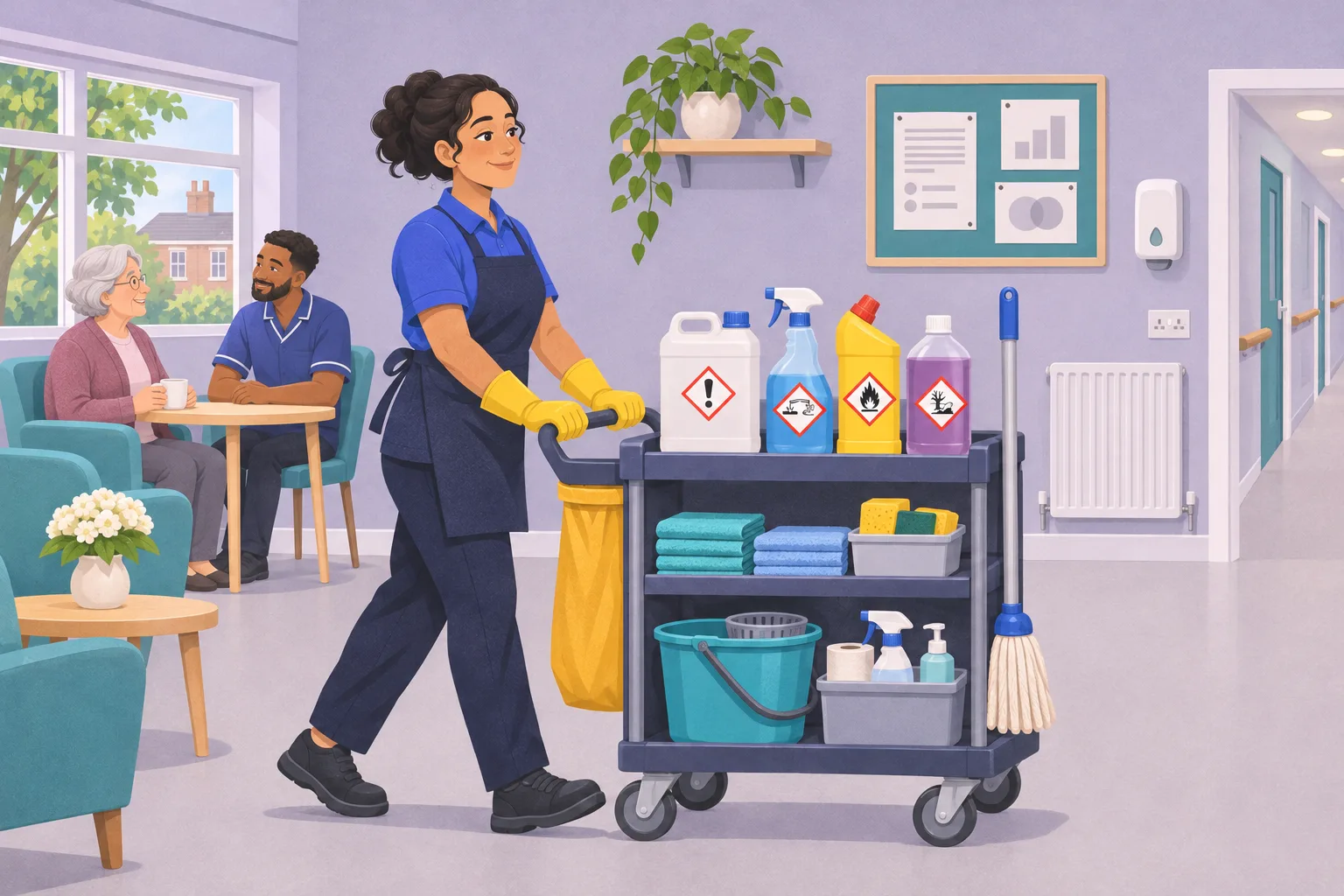
A cleaner in rubber gloves pushes a trolley of cleaning products, each container marked with a small hazard diamond

Awareness only. This course is awareness training, not a qualification, and it isn't legal advice. It has not been reviewed by a professional body, and it doesn't replace practical training for your job or your employer's COSHH assessment. It covers Great Britain. Northern Ireland has its own COSHH (NI) 2003, and the COSHH duties in this course have the same regulation numbers there.

What it covers, and what it doesn't

COSHH covers chemicals and products containing chemicals, fumes, dusts, vapours, mists, gases and germs. It isn't only about labelled products: HSE gives wood dust from sanding, silica dust from tile cutting and fumes from welding as examples your own work can create.

The harm can be immediate, such as stinging eyes or dizziness, or take many years to develop, such as lung disease.

COSHH doesn't cover lead, asbestos or radioactive substances: they have their own regulations. Its main duties also don't apply where a substance is hazardous only because it is flammable or explosive, or only because it is at a high or low temperature or a high pressure.

Breathing in

Skin and eyes

Swallowing

Your employer's duties

Under COSHH, your employer must:

  • assess the risk to your health

  • prevent exposure or, where that isn't reasonably practicable, adequately control it

  • keep controls and protective equipment in good working order

  • monitor exposure where the assessment shows it's needed

  • provide health surveillance where it's appropriate

  • give you information, instruction and training, including access to the safety data sheets for your work.

Work that could expose you mustn't start until the risk is assessed and the necessary steps are taken.

Your duties

COSHH says you must make full and proper use of the controls provided, take all reasonable steps to put equipment back where it's kept after use, and report any defect to your employer straight away: [Your organisation: who to report a spill, defect or symptom to]. You must also attend health surveillance when your employer requires it, in working hours and at their cost: [Your organisation: health surveillance, if it applies to your work].

Who does what, and what should nobody do? Sort each card. You'll meet the last group again in lesson 4.

0 of 9 sorted

Sources: Control of Substances Hazardous to Health Regulations 2002 (SI 2002/2677, as amended), regulations 2 and 5 to 12 (legislation.gov.uk, revised text, read 21 November 2026); COSHH (Northern Ireland) 2003 (SR 2003/34); HSE web pages on COSHH (updated 2025 and 2026); HSE, INDG136(rev5), Working with substances hazardous to health (2012); HSE, CAIS22(rev2) (2017) and COSHH essentials SR2 (2025).

These are awareness courses. They are not legal advice, they are not accredited and they have not been reviewed by a professional body. They don't replace practical training or your organisation's own risk assessment and policies.

Sources

About this course

Length
25 min
Lessons
5
Language
English
Law covered
Great Britain (COSHH Regulations 2002 as amended; GB CLP); Northern Ireland: COSHH (NI) 2003 with the same regulation numbers, EU CLP with the same pictograms
Last reviewed
21 November 2026
Next review
21 November 2027
Version
1

Common questions

Is this course really free?

Yes. Start a free 14-day trial and the course is in your portal straight away, branded to you, with no card needed. Every paid plan includes it at no extra cost.

Can I add this course to my own LMS?

Yes. Export it as a SCORM 1.2 or SCORM 2004 package and upload it to any LMS that supports SCORM. A free trial includes one SCORM export.

Can I add our own policies and contacts?

Yes. The course marks where to add your organisation's details, and the copy in your portal is yours to edit.

Is this course accredited?

No. It is awareness training. It is not accredited or CPD-certified and has not been reviewed by a professional body.

More free courses

Health & safety

Display Screen Equipment

Display screen equipment (DSE) awareness for office, hybrid and home workers in Great Britain and Northern Ireland: who counts as a DSE user, what the law asks of employers, how to set up a workstation and a laptop, breaks, eye tests and when to report discomfort.

25 min · 5 lessons · United Kingdom

Reviewed 21 November 2026

Health & safety

Fire Safety Awareness

How fire starts and spreads, what fire safety law in England and Wales, Scotland and Northern Ireland asks of your employer and of you, spotting and reporting fire hazards, what to do if you discover a fire or hear the alarm, and when and which extinguisher to use.

25 min · 5 lessons · United Kingdom

Reviewed 21 November 2026

Health & safety

Lone Working

When you can work alone and who stays responsible for your safety, the risks HSE names (including verbal, phone and online abuse), and how check-in and escalation work, from your side and the duty contact's. Practise a doorstep decision and a missed check-out. GB law, with Northern Ireland notes.

20 min · 4 lessons · United Kingdom

Reviewed 21 November 2026

Give your team a portal with these courses already in it

Start a free 14-day trial, choose your courses and invite your learners in minutes.