
Health & safety

Fire Safety Awareness

How fire starts and spreads, what fire safety law in England and Wales, Scotland and Northern Ireland asks of your employer and of you, spotting and reporting fire hazards, what to do if you discover a fire or hear the alarm, and when and which extinguisher to use.

  • 25 min
  • 5 lessons
  • English, Welsh
  • United Kingdom
  • Last reviewed 21 November 2026

Covers: UK: England and Wales (Regulatory Reform (Fire Safety) Order 2005), Scotland (Fire (Scotland) Act 2005 Part 3 and Fire Safety (Scotland) Regulations 2006), Northern Ireland (Fire and Rescue Services (NI) Order 2006 and Fire Safety Regulations (NI) 2010)

What you will learn

  • How fire starts and spreads

    Explain the three things a fire needs, how fire and smoke spread, and the common causes of fires in buildings other than homes.

  • The law and your part

    Describe what fire safety law asks of your employer, or whoever controls the premises, and of you, in England and Wales, Scotland and Northern Ireland.

  • Spotting and reporting hazards

    Spot fire hazards, wedged fire doors and blocked escape routes, and report them to the right person.

  • When there is a fire

    Raise the alarm, call 999, leave by the nearest safe exit, go to your assembly point and stay out.

  • Using extinguishers

    Know when an extinguisher may be used and by whom, and which type suits which kind of fire.

How this course was checked

  • More than 160 statements traced to 6 sources
  • Checked twice, independently, before publication. Every correction was checked again.
  • Last reviewed 21 November 2026. Next review due 21 November 2027.

What changed

  • 1 First published.
Spotted something wrong or out of date? Report an error

Report an error

Tell us what looks wrong or out of date in Fire Safety Awareness, and where. We check every report against the sources and correct the course if needed.

Lessons

1 module, 5 lessons

  1. Fire safety at work

    • How fire starts and spreads The three things a fire needs, where fires start, and how fire and smoke spread.
    • The law and your part Which fire safety law applies where you work, what it asks of your employer and of you, and the hazards to report.
    • If there is a fire What to do if you discover a fire or hear the alarm, and how to get out and stay out.
    • Extinguishers: when, and which When an extinguisher may be used and by whom, and which type suits which fire.
    • Check your understanding Eight questions on the whole course. You need 80% to pass.

Try the first lesson

This is the first lesson exactly as your learners will see it. The rest of the course opens in your own portal.

Lesson 1: How fire starts and spreads
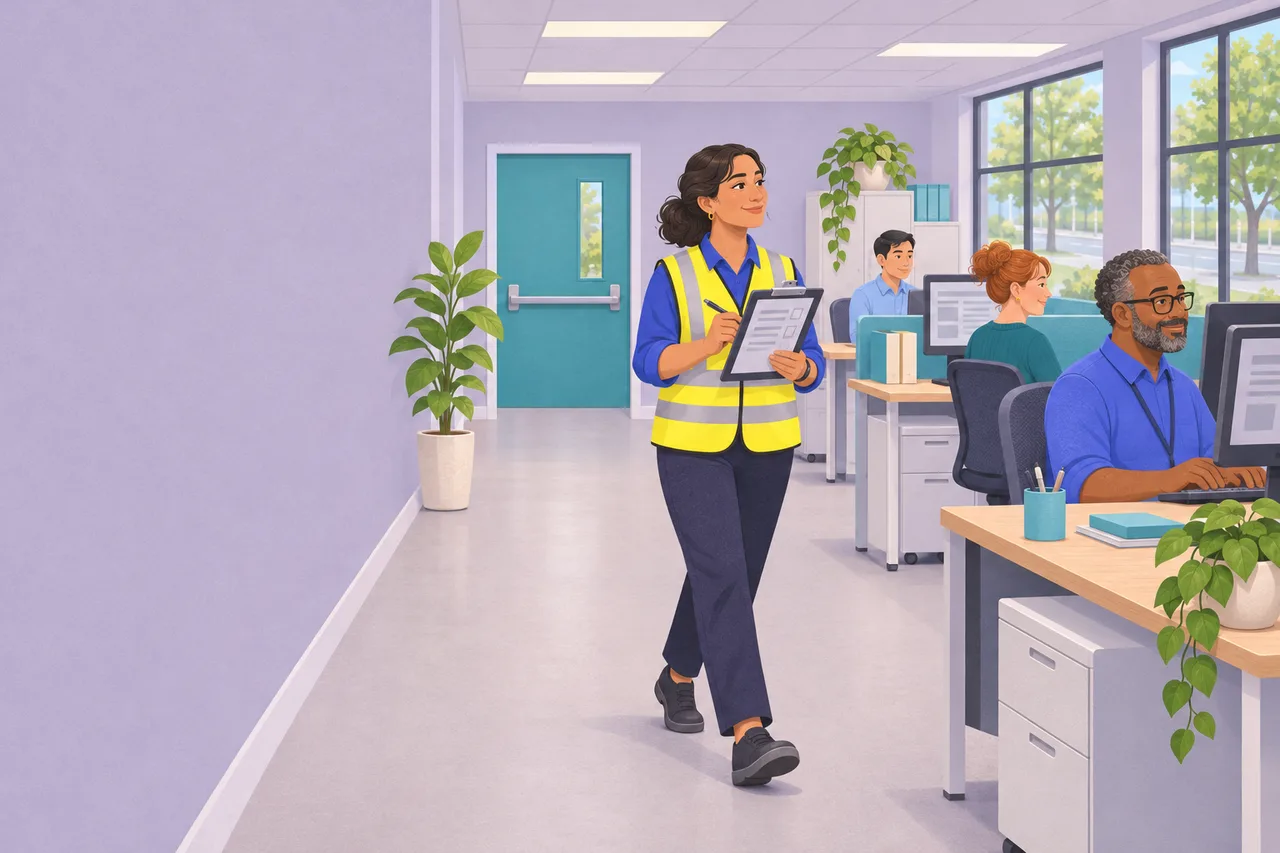
A fire warden in a yellow high-visibility vest walks through a tidy, bright office with a clipboard, checking that the way to the fire exit at the far end is clear, while colleagues work at their desks

Fire safety: prevent fires, raise the alarm and get everyone out

How fire starts and spreads

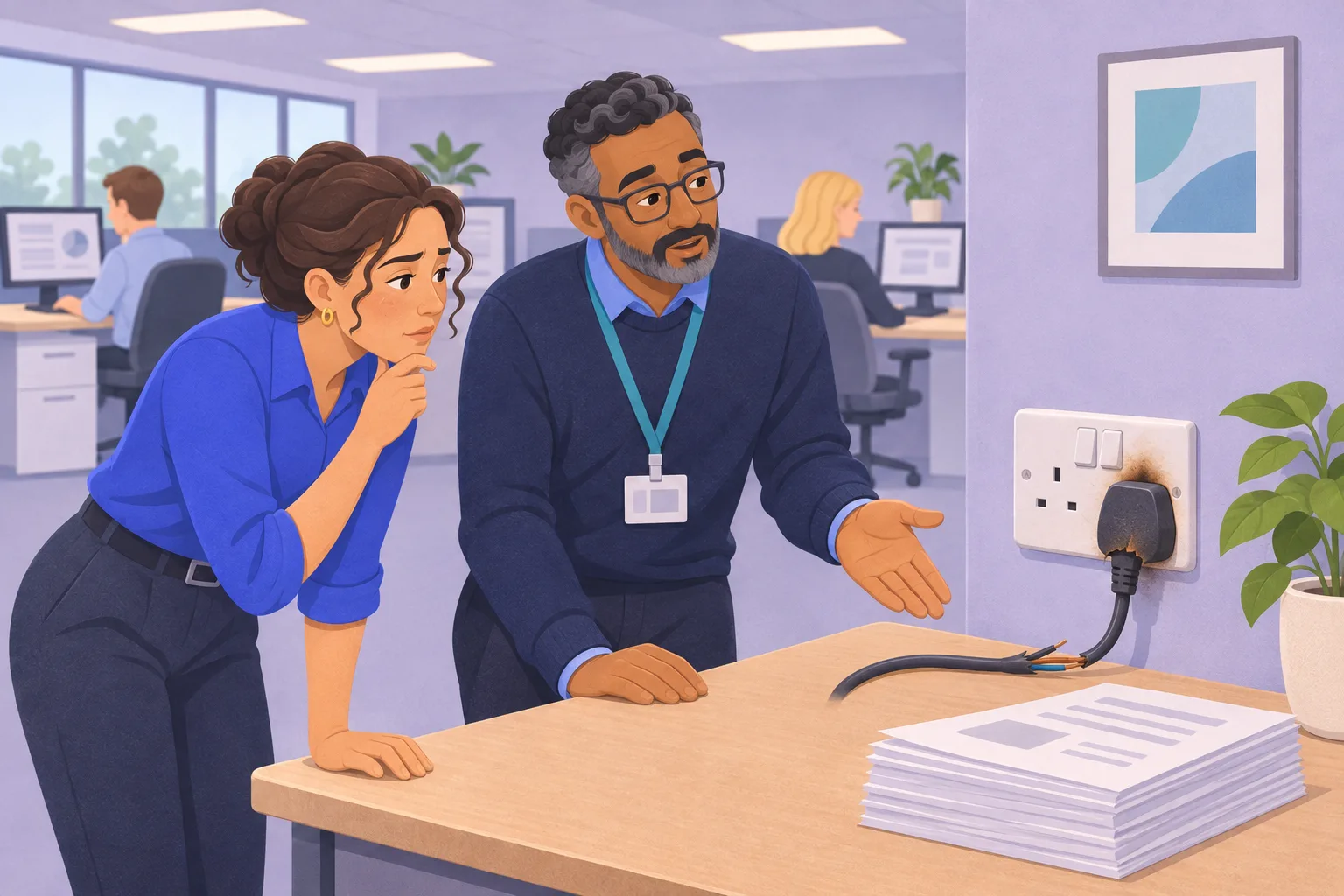
A charger has been plugged into the wall socket behind a desk for months, next to a stack of paper, its cable split where it bends. Nothing looks wrong until the plug starts to scorch.

The corner of a desk: a scorched plug in a wall socket, its cable split, beside a stack of paper

Awareness only. This course is awareness, not a qualification, and it isn't legal advice. It doesn't replace your organisation's fire risk assessment, its fire procedures or the training for a fire safety role: fire wardens and marshals need more comprehensive training.

The fire triangle

For a fire to start, three things are needed: a source of ignition (heat), fuel and oxygen. If any one of them is missing, a fire cannot start, so preventing fire means stopping the three from coming together.

Heat

Fuel

Oxygen

Sort each item to the side of the fire triangle it belongs to.

0 of 9 sorted

Where fires start

Electrical equipment and wiring are common causes of fire. The most recent detailed figures for England show where fires in buildings other than homes come from (Wales, Scotland and Northern Ireland publish their own). Those buildings include workplaces, but also hotels, care homes and private garages and sheds.

Fires in buildings other than homes, England, year to March 2026

  • 13,679Firesprimary fires in buildings other than homes, attended by fire and rescue services.
  • 1,750Faulty appliances and leadsfires had an accidental cause recorded as faulty appliances and leads.
  • 998Too close to heatfires had an accidental cause recorded as placing articles too close to heat.
  • 27%Deliberatewere recorded as deliberate (3,726 fires): keep bins and rubbish clear of the building.
MHCLG, England only: FIRE0301 (22 July 2026); FIRE0601 and detailed analysis (19 August 2026).

Electrical distribution, such as wiring and plugs, was the largest specified ignition source: 17%.

How fire spreads

Once a fire has started, it spreads in three ways: convection, conduction and radiation. The government's guide calls convection the most dangerous.

Convection

Conduction

Radiation

Why smoke matters. Smoke contains toxic gases. In a building with modern fittings and materials it is thick and black: it obscures vision, makes breathing very difficult and can block escape routes. That is why the rest of this course is about reporting hazards, keeping doors shut and getting out early.

Sources: Fire safety risk assessment: offices and shops (HM Government guide, 2006; gov.uk page updated 12 September 2023), Step 1 and Step 3.2; A guide to making your small non-domestic premises safe from fire (gov.uk, updated 20 January 2025), section 4; MHCLG, Detailed analysis of fires and response times to fires attended by fire and rescue services, England, year ending March 2026 (19 August 2026); MHCLG fire statistics data tables FIRE0301 (22 July 2026), FIRE0601 and FIRE0602 (19 August 2026); MHCLG, Fire statistics definitions.

These are awareness courses. They are not legal advice, they are not accredited and they have not been reviewed by a professional body. They don't replace practical training or your organisation's own risk assessment and policies.

Sources

About this course

Length
25 min
Lessons
5
Languages
English, Welsh
Law covered
UK: England and Wales (Regulatory Reform (Fire Safety) Order 2005), Scotland (Fire (Scotland) Act 2005 Part 3 and Fire Safety (Scotland) Regulations 2006), Northern Ireland (Fire and Rescue Services (NI) Order 2006 and Fire Safety Regulations (NI) 2010)
Last reviewed
21 November 2026
Next review
21 November 2027
Version
1

Common questions

Is this course really free?

Yes. Start a free 14-day trial and the course is in your portal straight away, branded to you, with no card needed. Every paid plan includes it at no extra cost.

Can I add this course to my own LMS?

Yes. Export it as a SCORM 1.2 or SCORM 2004 package and upload it to any LMS that supports SCORM. A free trial includes one SCORM export.

Can I add our own policies and contacts?

Yes. The course marks where to add your organisation's details, and the copy in your portal is yours to edit.

Is this course accredited?

No. It is awareness training. It is not accredited or CPD-certified and has not been reviewed by a professional body.

More free courses

Health & safety

COSHH Awareness

COSHH awareness for cleaning, catering, maintenance and workshop staff in Great Britain: what COSHH covers, how to read a label's hazard pictograms and signal words, the safety data sheet sections to read first, COSHH's order of controls with PPE last, and how to protect your skin and breathing.

25 min · 5 lessons · United Kingdom

Reviewed 21 November 2026

Health & safety

Display Screen Equipment

Display screen equipment (DSE) awareness for office, hybrid and home workers in Great Britain and Northern Ireland: who counts as a DSE user, what the law asks of employers, how to set up a workstation and a laptop, breaks, eye tests and when to report discomfort.

25 min · 5 lessons · United Kingdom

Reviewed 21 November 2026

Health & safety

Lone Working

When you can work alone and who stays responsible for your safety, the risks HSE names (including verbal, phone and online abuse), and how check-in and escalation work, from your side and the duty contact's. Practise a doorstep decision and a missed check-out. GB law, with Northern Ireland notes.

20 min · 4 lessons · United Kingdom

Reviewed 21 November 2026

Give your team a portal with these courses already in it

Start a free 14-day trial, choose your courses and invite your learners in minutes.