Health & safety

Manual Handling Awareness

How to lift, carry, push and pull safely at work: what the law asks of you and your employer, how injuries happen, how to assess a load and good handling technique.

  • 30 min
  • 5 lessons
  • English, Welsh
  • United Kingdom
  • Last reviewed 20 November 2026

Covers: Great Britain (England, Scotland, Wales); Northern Ireland has equivalent regulations

What you will learn

  • Why manual handling matters

    Explain what counts as manual handling in law and why it is one of the main causes of back pain and other musculoskeletal disorders.

  • Avoid, assess, reduce

    Describe the order in which your employer must deal with manual handling risk, and why there is no legal weight limit.

  • Spotting risk with TILE

    Sort risk factors into task, individual, load and environment, and use HSE's filter weights as a first check, not a limit.

  • Good handling technique

    Follow HSE's good handling technique for a lift, and apply the key points for pushing, pulling and team handling.

  • Your part

    Use the systems of work and handling aids provided, report aches and pain early, and know who to tell.

How this course was checked

  • More than 100 statements traced to 6 sources
  • Checked twice, independently, before publication. Every correction was checked again.
  • Last reviewed 20 November 2026. Next review due 20 November 2027.

What changed

  • 1 First published.
Spotted something wrong or out of date? Report an error

Report an error

Tell us what looks wrong or out of date in Manual Handling Awareness, and where. We check every report against the sources and correct the course if needed.

Lessons

2 modules, 5 lessons

  1. Risk and the law

    • Why manual handling matters What counts as manual handling, how it harms people, and the law that applies in Great Britain.
    • Assessing the risk Why weight alone doesn't decide the risk, the four things to look at, and HSE's quick filter.
  2. Handling safely

    • Good handling technique HSE's good handling technique for a lift, and the key points for pushing, pulling and lifting as a team.
    • Putting it into practice Make the call in a real situation, report aches and pain early, and know your part.
    • Check your understanding Eight questions on the whole course. You need 80% to pass.

Try the first lesson

This is the first lesson exactly as your learners will see it. The rest of the course opens in your own portal.

Lesson 1: Why manual handling matters
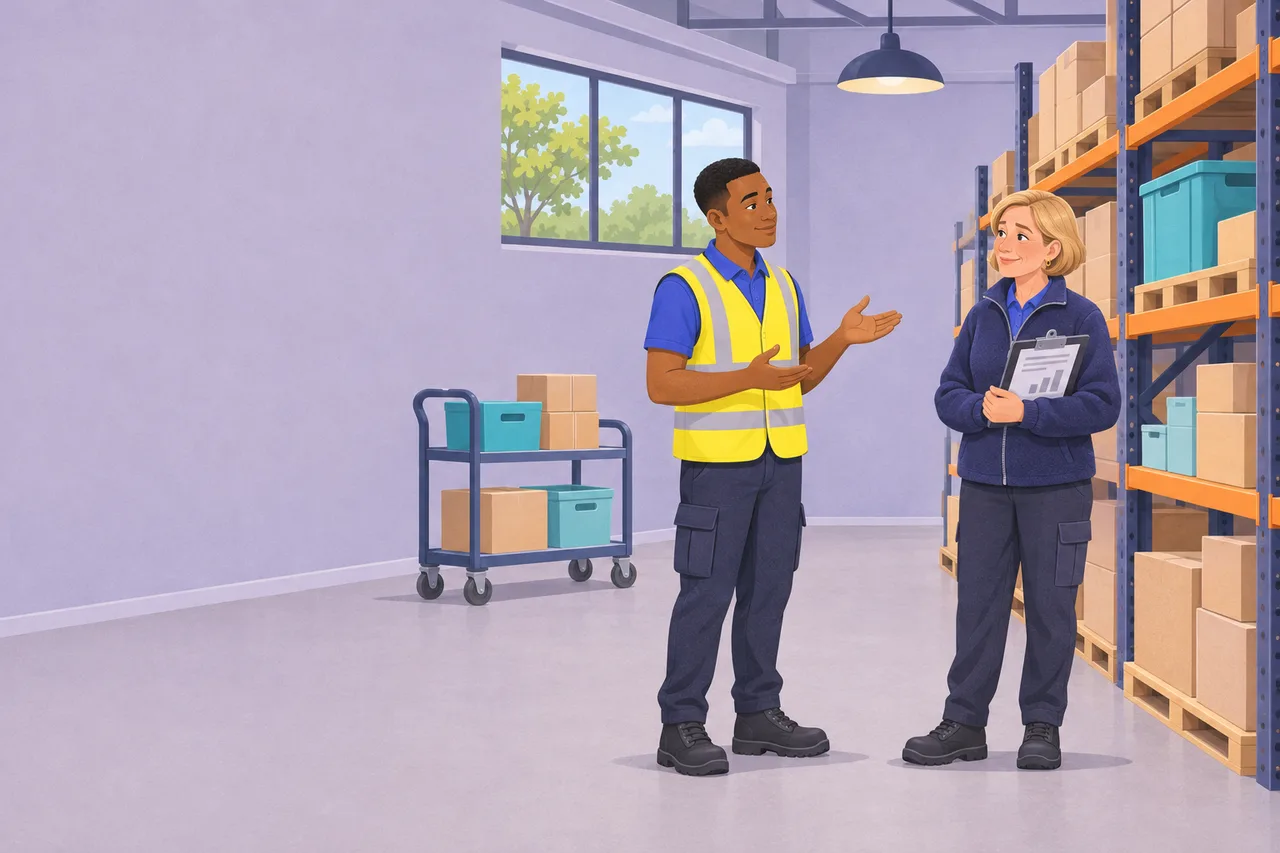
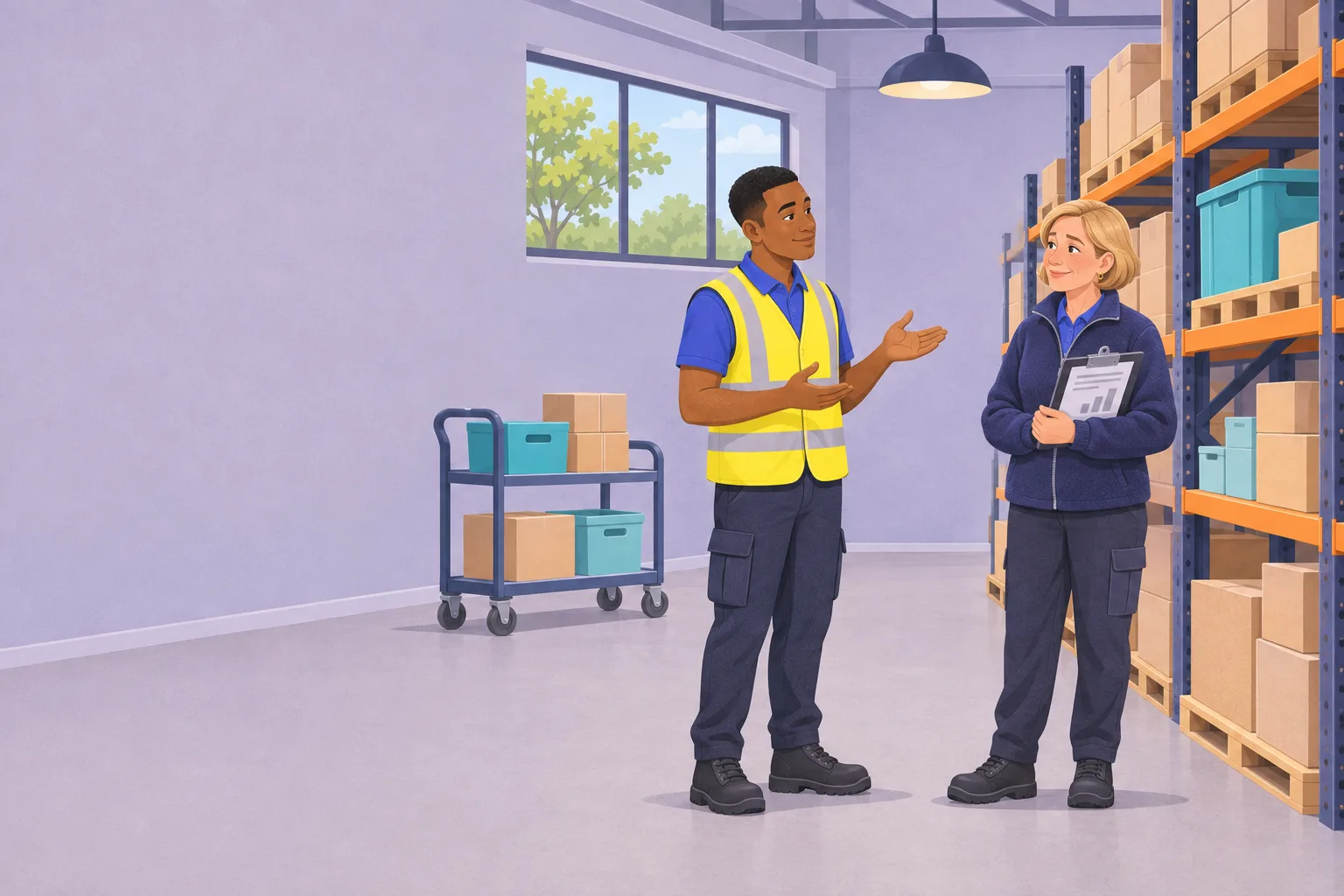
Two people talking in a warehouse aisle, one in a high-visibility vest

Manual handling: lift, carry, push and pull without hurting yourself

Why manual handling matters

Carrying a crate of drinks up from a cellar. Pushing a loaded roll cage. Helping someone stand up from a chair. Holding a panel steady while a colleague fixes it. All of these are manual handling: in law, transporting or supporting a load by hand or by bodily force. A load can be an object, a person or an animal, and you'll find the risks on farms and building sites, in factories, offices, warehouses and hospitals, and on deliveries.

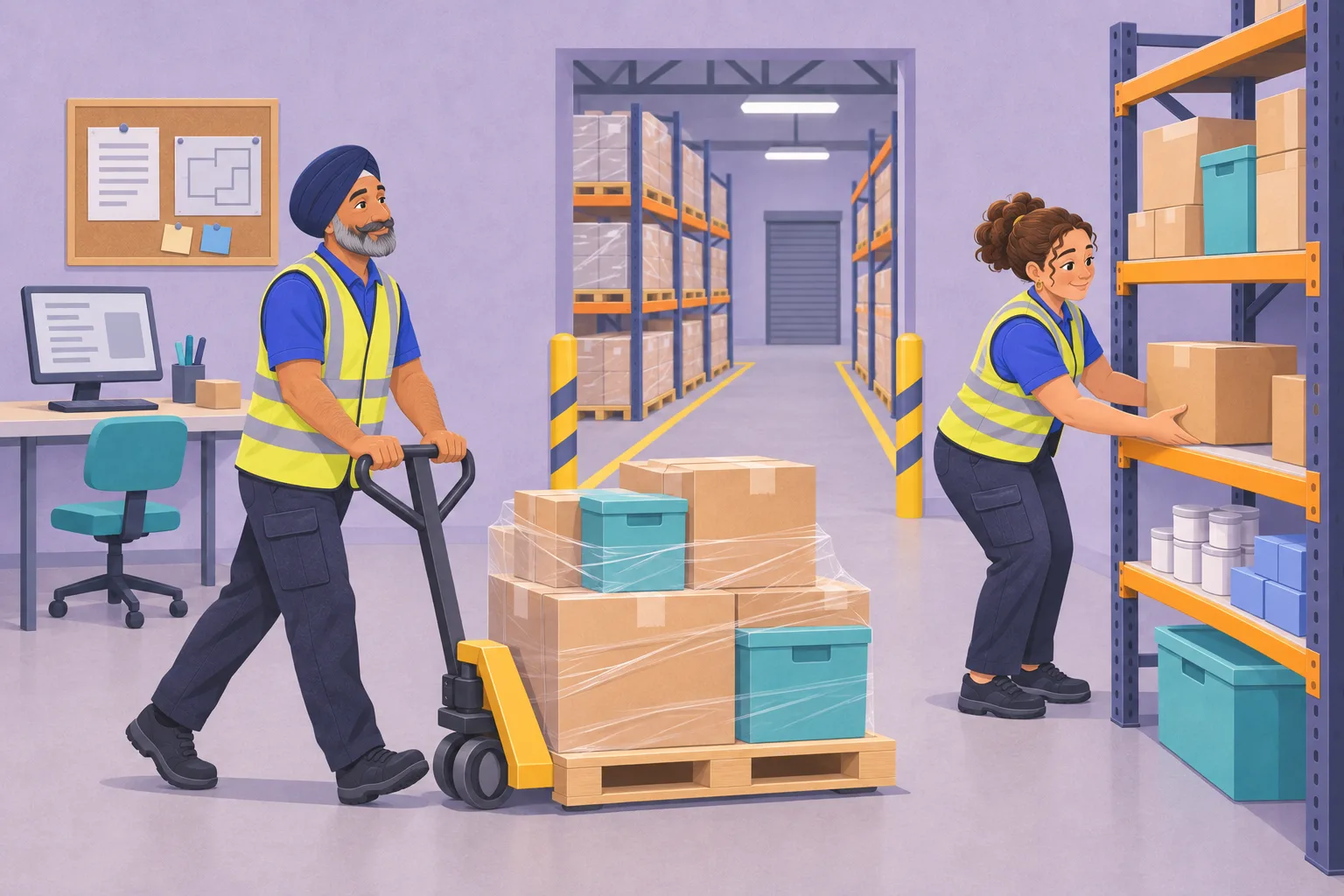
A stockroom: one worker pushes a loaded hand pallet truck while another puts a box on a shelf at waist height

Awareness only. This course doesn't replace practical training for your own tasks or your employer's risk assessment, and it isn't legal advice. It covers the law in Great Britain; Northern Ireland has equivalent regulations, enforced by HSENI and the district councils.

Work-related musculoskeletal disorders (MSDs) and handling injuries, Great Britain, 2025/26

  • 38%The backof work-related MSD cases mainly affected the back. The upper limbs or neck came next, at 37%.
  • 15.7Days lost per caseworking days were lost, on average, for each case of a work-related MSD.
  • 18%Handling injuriesof non-fatal injuries to employees reported by employers came from handling, lifting or carrying.
Source: HSE statistics, November 2026.

How it hurts people

Manual handling is one of the main causes of musculoskeletal disorders (MSDs), particularly back pain. An MSD is any injury, damage or disorder of the joints or other tissues in the back or the upper or lower limbs. Most develop over time, through repeated movements, awkward postures and too little recovery. A single accident can cause one too.

In 2025/26, an estimated 477,000 workers in Great Britain had a work-related musculoskeletal disorder.

Manual handling
Transporting or supporting a load by hand or bodily force, including lifting, putting down, pushing, pulling, carrying or moving it.
Load
Any object you handle, and also any person or any animal.
MSD
A musculoskeletal disorder: any injury, damage or disorder of the joints or other tissues in the upper or lower limbs or the back.
Reasonably practicable
Weighing the risk against the money, time or trouble needed to control it.

The law in Great Britain

In England, Scotland and Wales the law is the Manual Handling Operations Regulations 1992. Your employer must avoid hazardous manual handling so far as is reasonably practicable, assess the risk of any that can't be avoided, and reduce that risk to the lowest level reasonably practicable. You must make full and proper use of any system of work your employer provides to reduce the risk. The next lesson shows how the assessment works.

Sources: HSE, Work-related musculoskeletal disorders statistics in Great Britain, 2026 (19 November 2026) and Health and safety at work: Summary statistics for Great Britain 2026 (November 2026); Manual Handling Operations Regulations 1992 and (Northern Ireland) 1992, legislation.gov.uk; HSE, INDG143(rev4) (January 2020); HSE, L23, fourth edition (2016).

These are awareness courses. They are not legal advice, they are not accredited and they have not been reviewed by a professional body. They don't replace practical training or your organisation's own risk assessment and policies.

Sources

About this course

Length
30 min
Lessons
5
Languages
English, Welsh
Law covered
Great Britain (England, Scotland, Wales); Northern Ireland has equivalent regulations
Last reviewed
20 November 2026
Next review
20 November 2027
Version
1

Common questions

Is this course really free?

Yes. Start a free 14-day trial and the course is in your portal straight away, branded to you, with no card needed. Every paid plan includes it at no extra cost.

Can I add this course to my own LMS?

Yes. Export it as a SCORM 1.2 or SCORM 2004 package and upload it to any LMS that supports SCORM. A free trial includes one SCORM export.

Can I add our own policies and contacts?

Yes. The course marks where to add your organisation's details, and the copy in your portal is yours to edit.

Is this course accredited?

No. It is awareness training. It is not accredited or CPD-certified and has not been reviewed by a professional body.

More free courses

Health & safety

COSHH Awareness

COSHH awareness for cleaning, catering, maintenance and workshop staff in Great Britain: what COSHH covers, how to read a label's hazard pictograms and signal words, the safety data sheet sections to read first, COSHH's order of controls with PPE last, and how to protect your skin and breathing.

25 min · 5 lessons · United Kingdom

Reviewed 21 November 2026

Health & safety

Display Screen Equipment

Display screen equipment (DSE) awareness for office, hybrid and home workers in Great Britain and Northern Ireland: who counts as a DSE user, what the law asks of employers, how to set up a workstation and a laptop, breaks, eye tests and when to report discomfort.

25 min · 5 lessons · United Kingdom

Reviewed 21 November 2026

Health & safety

Fire Safety Awareness

How fire starts and spreads, what fire safety law in England and Wales, Scotland and Northern Ireland asks of your employer and of you, spotting and reporting fire hazards, what to do if you discover a fire or hear the alarm, and when and which extinguisher to use.

25 min · 5 lessons · United Kingdom

Reviewed 21 November 2026

Give your team a portal with these courses already in it

Start a free 14-day trial, choose your courses and invite your learners in minutes.