
Ask any learning platform whether it has an API and the answer is yes. The useful question is whether it has an API your developers can build on without surprises: one that is documented in public, behaves the same way everywhere, tells you its limits and doesn't change under your feet.
This checklist is for membership bodies, professional bodies and training providers choosing an LMS that has to talk to other systems, usually a membership database or CRM, sometimes an intranet or a finance system. Use it to brief your developer or supplier, and to ask vendors sharper questions.
Key Takeaways
- Start with what you need to connect
- The table stakes
- Where LMS APIs differ: questions to ask
- Security questions for your IT team
Start with what you need to connect
Before comparing APIs, write down the journeys that cross between systems. For most membership organisations the list looks like this:
- A member joins and should get an LMS account, in the right groups, without anyone retyping their details.
- A member's grade or region changes and their groups, and so their courses, should follow.
- A member completes a course and the completion, CPD hours and certificate should land on their record.
- A member pays for a course or event and finance needs to know.
- A member signs in to your portal and should reach their courses without a second password.
Each journey tells you which parts of the API matter: users and groups, enrolments, progress, webhooks and some form of sign-in hand-off.
The table stakes
A buyer should expect every one of these. If a platform is missing one, find out how its customers work around it.
- A REST API with JSON and a version in the path, such as
/api/v2. - Server-side keys that an administrator can create, limit and revoke, rather than one shared password.
- Users: create, update, deactivate and find, ideally by your own membership number.
- Groups, so membership grades, cohorts or regions can drive access to courses.
- Enrolments: enrol and unenrol, and list who is on what.
- Progress and completions: percentage, dates and results, per learner and per course.
- Paginated lists, so large teams don't time out.
- Rate limits that return a 429 with headers saying when to try again.
- Webhooks for at least new users, enrolments and completions, so you aren't polling.
- Single sign-on for staff and members who already have an identity provider.
Where LMS APIs differ: questions to ask
Beyond the basics, LMS APIs vary a lot in the details that decide how much your integration costs to build and run. These are the questions that separate them.
| Ask | Why it matters | A good answer |
|---|---|---|
| Can we read the documentation before we sign? | Your developer can judge the effort, and spot gaps, before you commit. | Public guides and a downloadable OpenAPI spec, with no login or sales call. |
| What are the rate limits? | A nightly sync of thousands of members has to fit inside them. | Numbers, published, with headers that show what is left. |
| How are webhooks signed? | An unsigned webhook can be forged by anyone who learns the URL. | An HMAC over the event id, a timestamp and the body, so forged and replayed requests can be rejected. |
| What happens when you change the API? | An unannounced change can break your sync on a Friday afternoon. | A written deprecation policy with months, not weeks, of notice, and a changelog. |
| Can we retry safely? | Networks time out. A blind retry can enrol someone twice. | Idempotent updates, and an idempotency key on create requests. |
| Is the API on our plan? | Some platforms keep the API for top tiers or charge for it separately. | Included on every plan, with the same limits. |
| Can we use our own ids? | Your membership system shouldn't have to store the LMS's ids. | Look people up, and enrol them, by your membership number. |
Two more are worth asking if you are a membership or professional body. Does the API cover the data you actually report on, such as CPD hours, certificates with a public verification link, events and attendance? And can it hand a member from your own portal into the LMS without a second sign-in, without that becoming a way round two-factor authentication for administrators?
Security questions for your IT team
- How are keys stored? A key should be shown once and stored only as a hash, so a database leak doesn't leak working keys.
- Can a key be limited? A reporting tool shouldn't be able to delete users. Look for scopes per key, and expiry dates.
- Is each organisation isolated? A key should only ever see its own organisation's data, whatever address it calls.
- What can the API change? It should not be able to create administrators, or rewrite the accounts of people with more access than a learner.
- Are webhook endpoints checked? Look for HTTPS only, and a refusal to send to private network addresses.
- Is there an audit trail for anything that signs a person in?
Red flags
- The documentation is only available after you sign, or as a PDF from the sales team.
- Every error comes back as a 200 with a message inside, or as an HTML error page.
- "Unlimited" requests, with no number. Somewhere there is a limit; you just won't know until you hit it.
- Webhooks with no signature, or a fixed shared header that never changes.
- No changelog, and no answer to "what notice do you give before a change?"
- The API is an add-on priced per call, so a growing membership means a growing bill.
How Continuum Learn's API measures up
We built the Continuum Learn API against this list. API v2 covers the catalogue, users, groups, enrolments, learner progress (including quiz results and attendance) and every issued certificate with its verification link. Keys are named, scoped, stored as a hash, can expire and are revoked in one click. Learners can be found and enrolled by your own membership number.
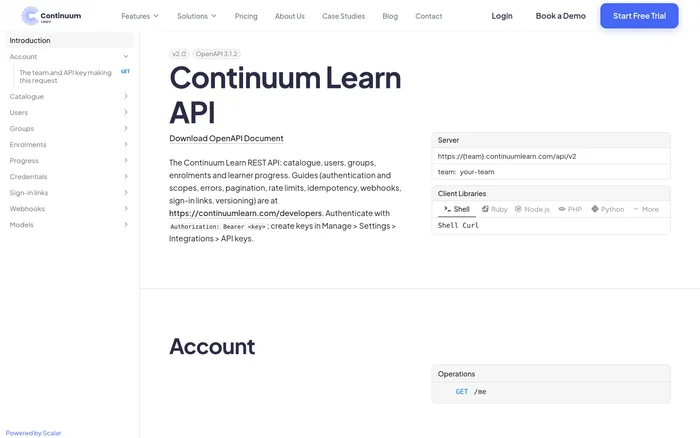
- Public documentation on the developer portal, and an OpenAPI 3.1 spec you can import into Postman without an account.
- Published limits: 300 requests a minute per key and 600 per IP address, with rate-limit headers.
- Safe retries, with an
Idempotency-Keyon every create request. - Webhooks signed to the Standard Webhooks specification, with an event id and timestamp in every signature, and retries for about 27 hours.
- Sign-in links that move a learner from your portal into Continuum, refused for administrators and for anyone using two-factor authentication.
- A written policy: additive changes only within a version, and at least 12 months' notice before anything is removed.
- Every plan: the API, webhooks and website embeds are included at no extra cost.
Conclusion
Take this checklist into your next vendor conversation, and ask to see the documentation before the demo. If you would like to walk through the Continuum Learn API with your membership system in mind, book a demo, or send your developer straight to getting started.
Frequently asked questions
What should an LMS API include?
At a minimum: users, groups, enrolments and learner progress, readable and writable over a versioned REST API with server-side keys, paginated lists, rate limits that return a 429 with headers, and webhooks for events such as enrolments and completions.
Why do signed webhooks matter?
A webhook arrives at a public URL. Without a signature, anyone who learns the URL can send fake events. A signature over the event id, a timestamp and the body lets the receiver reject forged and replayed requests.
Should an LMS API cost extra?
It doesn't have to. Some platforms include the API on every plan, while others limit it to higher tiers or sell it as an add-on. Ask before you sign, and check whether webhooks and higher limits cost more too.
What is an OpenAPI spec?
A machine-readable description of every endpoint, parameter and response in an API. Developers can read it in a viewer, import it into tools such as Postman, and generate client code from it.
Found this useful? Share it with your network
Ready to transform your training?
See how Continuum Learn helps organisations deliver impactful learning experiences at scale.